This is the third lesson in a sequence for Prep/Foundation year that I delivered on my first practical experience. This practicum was in week 1 of term 4 so the students had been trained well of overall school expectations. The school had an above average ICSEA value meaning it had a slight socio-educational advantage. Overall, my supervising teacher had trained the students well in regards to learning expectations.
Learning Intentions/Objectives
Students will be able to:
Success Criteria
Students:
- can count sequences and answer the question “How many objects are there?”.
- can connect each number name with its numeral and a quantity.
- understand that there can be different representations of the same quantity.
Start by recapping key vocabulary list:


Australian Curriculum Strand
Mathematics: Number and Algebra
Sub-strand: Number and Place Value
Content description: Connect number names, numerals and quantities, including zero, initially up to 10 and then beyond (ACMNA002).
General capabilities
Numeracy: connect and order number names, numerals and groups of objects using numbers up to two digits
Critical and Creative Thinking: considering alternatives and creative ways to approach the Phase 3 Consolidation Task.
Personal and Social Capability: students work in pairs sharing thoughts, ideas and experiences.
Assessment Strategies
Phase 2: Formative Assessment – teacher observes participation. Can students answer questions. Can students read numerals and work out pictorial representations, and present puzzle piece in correct sequence? Make any notations on observation sheet as to student understanding.
Phase 3: Formative Assessment: Teacher moves around room during consolidation activity, asks focus questions and observes students arranging numerals, number names and manipulatives. Note on observation sheet students who:

Collect photos of samples of student work.
Phase 1 – 5 mins
Have students sit on the carpet for the initial learning and ensure that you allow wait time for information processing.
Recap:
PST will need to pin complete Teacher Toolkit to board.
- Does anyone remember what we did in our last math lesson? [matched numeral, number name and representations by way of a toolkit]
- We learnt about representing numbers in different ways:
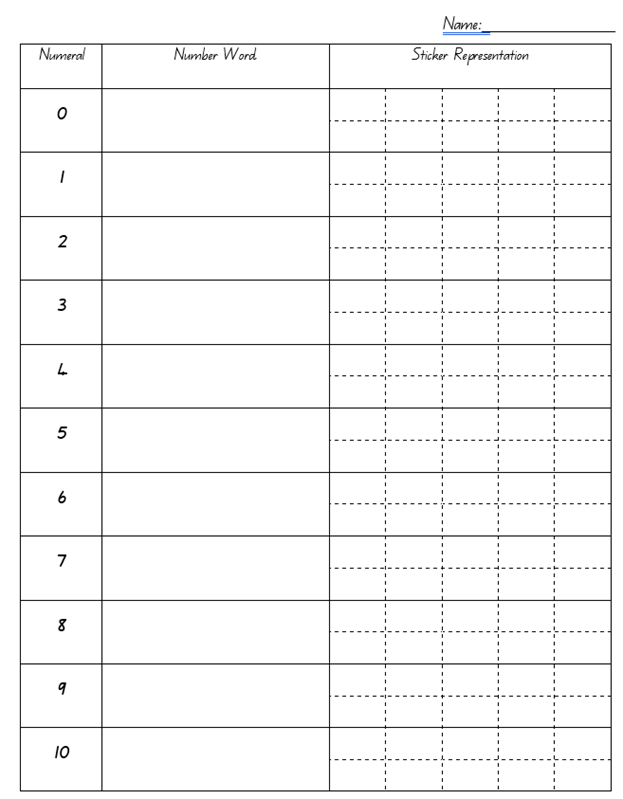
- with the numeral [demonstrate by pointing to Teacher Toolkit]
- in written form [demonstrate by pointing to Teacher Toolkit]
- and with stickers (or a picture representation) [demonstrate by pointing to Teacher Toolkit].
Ensure that the following toolkit has been completed so that you can pin this example to the board…
- Today, we are going to learn that:
- we can count lots of different things.
- when we count, we count each object once.
- and that the last number tells us ‘how many’ things or objects there are.
- We are going to create different groups of things to count and different ways to represent the same number.
Phase 2 – 10 mins
Start this activity by having students sit on the carpet.
Only count each object once
- Model counting different things and that we count each item only once. Have class join in Eg:
- clapping: clap in a rhythm. Students count how many claps and can repeat clapping if needed. Clap with a different rhythm but the same number of claps. Point out same number, different pattern.
- count the class: I wonder how many students are in this class? start the counting, then have each child count themselves. Reinforce that the last child counted/last number, is the total number of students in the class.
- Focus questions:
- Can you think of anything else we can count a group of? [pick one or two students and everyone counts their suggestion.]
- Can you think of something in the classroom?
Formative Assessment – teacher observes participation. Can students answer questions. Make notes on an observation sheet or use a checkbox template.
Matching numerals to representations

- Show students puzzle pieces [0-10].
- Ask student to help you match them up. Show one example: numeral 2 and explain that it can be represented by 2 objects or in this case pictures, 2 cupcakes.
- Hand out puzzle cards, one to each student. Differentiate numeral to Beginning/Consolidating students; picture representations to Consolidating/Established students. If a student is away, keep zero for yourself.
- Remind students how we found our puzzle partner yesterday. Ask them to find their puzzle partner and sit on the carpet in pairs when they have found their partner.
- Once students are all sitting on carpet, go through each puzzle card, numeral and representation. For example:
- Can you remember which numeral shows we have nothing? Which number comes before 1? [0] Ask student to bring up and teacher Blu-tacks to board. What picture might represent that we have nothing? [blank card]. Blu-tack to board.
- What comes after zero? [1]. Blu-tack to board. What picture represents that we have 1 of something? [1 doughnut]. Ask class to clap out how many doughnuts – all together clap 1. Teacher claps and says 1, 1 doughnut.
- Continue… [2] – Blu-tack to board. What picture represents we have 2 of something? [2 cupcakes]. Ask class to clap out how many cupcakes – all together clap 1, 2. Teacher claps and says 1, 2. 2 cupcakes.
- Continue process for all puzzle pieces.
Formative Assessment – teacher observes participation. Can students read numerals and work out pictorial representations, and present puzzle piece in correct sequence? Make any notations on observation sheet as to student understanding.
Allows 5 minute transition for students to move from the carpet to their desks.
Ask Teacher-Aide to assist in setting up worktables with consolidation activity.
Phase 3 – 10 mins
Consolidation Activity:
Students to work in pre-determined pairs. Students pick a numeral card or roll the dice to determine different ways to represent that number. Students will put their hand up when they have completed the activity for the ST or PST to check and provide feedback. Fast finishers repeat activity for supervising adult to check work and provide feedback.
- On the table is a stack of numbers and dice.
- There are also containers with different objects in them.
- Pick a number card or roll the dice. Then find as many different ways as you can to show me that number.
- Model for the number 3: stick “three”, 3 counters, 3 stacking cubes and domino that represents 3, to the board.

Focus questions:
- How many does that represent?
- Why did you represent the number that way?
- Can you find another way to represent the number?
- What do you see in your imagination when you think of that number? [say number]
Discuss representation with learners and give immediate feedback. Suggest having 2 or 3 goes to extend themselves. Encourage larger numbers if appropriate.
Differentiation:
- Various different manipulatives provided to allow for differentiation.
- Beginners can choose to roll dice only [numbers 1 – 6 only]
- Consolidating can roll dice [1-10] or choose uno number [0-9]
- Extending choose uno numeral 1 plus another numeral [0-9] or roll dice (numbers 12-20) and can represent number using dominos.
Formative Assessment: Teacher moves around room during activity, asks focus questions and observes students arranging numerals, number names and manipulatives. Note on observation sheet students who:
Add thoughts observation checklist.
Collect photos of samples of student work.
Plenary – 5 mins
Clean up manipulatives and put them in containers.
Discuss, today we learnt:
- that we can count lots of different objects. Can you remind me of some of the things we counted?
- One of the things we counted were the students in our class. Can anyone remember how we worked out how many students there are? [The last number answers the question “how many?”.]
- When counting, do we count the same object more than once? [No]
- that there can be different representations of the same quantity.
We also remembered that we know how to connect each number name with its numeral and a quantity of things.