The second lesson in a serious of lessons delivered to prep students during my first Professional Experience (PEx). The success criteria for this lesson was for students to be able to connect number names, numerals and representations, initially to 10 and then beyond.
Content descriptor
Connect number names, numerals and quantities, including zero, initially up to 10 and then beyond (ACMNA002).
Key vocabulary
Recap vocabulary from the first lesson.

Introduce new vocabulary and add it to a word wall.

Phase 1 – 10 mins
As math is straight after first break, spend the first 1 -2 minutes recapping on class expectations and learning expectations before beginning the lesson.
Recap on previous learning:
- In previous lesson we learnt to count forwards and backwards starting from any number. Call on a student, or two, to demonstrate: forwards from [8], [13]; backwards from [17], [3].
- This helped us identify what comes before or after a number. Call on a student, or two, to demonstrate: What comes before [9], [5] or after [10], [15].
- Ask: if anyone found ways to count forward or backward at home? Hands up. Call on 1 or 2 children to answer. Did they start from 1 or start from another number?
- Can anyone remember our vocabulary words from yesterday? [write on board]
- What happens to the number when you are counting forward?
- What happens to the number when you are counting backward?
Introduce this lessons learning.
Phase 2 – 15 mins
Matching numeral and number name
Set the scene: On the weekend we are hosting a Pokémon football game, and I need to hang the players shirts on the line in order. Instruct students to work as a team to find their number partner [model: 0 finds zero, 1 finds one, and so on]. Once number partner found, students sit back on carpet in pairs. Scaffold students with numerals and extend others with number names.
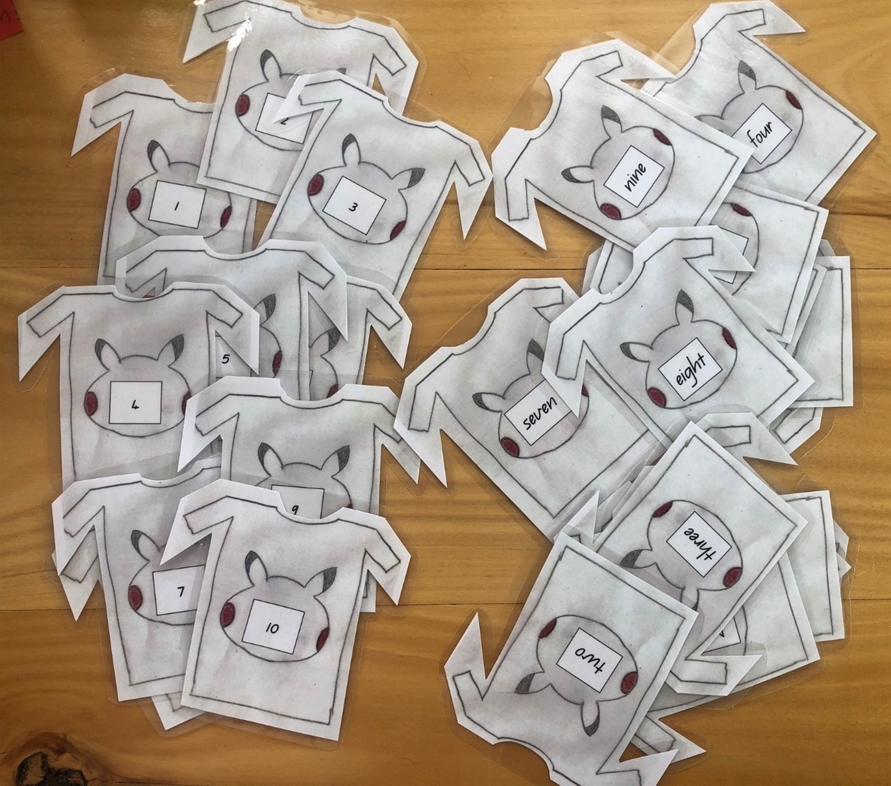
Ask focus questions:
- What’s another way of saying we have nothing of something? [0/zero] Who has the number 0? Peg on the line. Who has the written word zero? [if no one answers brainstorm what sound it starts with or ends with to work out who has it.] Peg on the line.
- What comes after zero? [1]. Who has the number 1? Peg on the line. Who has the written word one?
- If students don’t know written word: Nouns or naming words are often sight words, so we can’t sound this one out. But your teacher has been helping you this year and has your number name hang around the classroom. Can you see the number name for 1? Class participates in finding and identifying spelling of word. Student brings word to be hung on the line.
- Continue until all numerals and number name are hung on the line.
- To recap: Go through, pointing to each one and have the class say what they are [1]; [one]; [2]; [two]; etc
Formative Assessment: observe participation. Can students read the Pokemon shirt and present it in the correct sequence? Make notes on observation sheet as to whether they:

Allow 5 minute transition for students to move from the carpet to their desks.
Ask TA to assist in setting up worktables with consolidation activity.
Phase 3 – 15 mins
Matching numeral, number name and respresentation
Set the scene: Students will be completing the Numeral, Number name and representation toolkit.

Explicitly teach and model the exact steps required to complete the toolkit, including showing where the answers are found around the room. By explicitly modelling this numeracy activity, I am meeting Standard 1 of knowing my students and how they learn (AITSL, 2018; Cavanagh & Prescott, 2015).
The number names are precut (for those that need assistance) so that they only need to make one cut to get the number word. Small stickers are placed in the middle of the table so that they can choose a sicker to represent how many to place in the 10s frame. The zero line is the starting point so that everyone knows what they are doing and where to start.
Students work individually at tables to make the toolkit. As the TA hasn’t been available to support rotations, the Supervising Teacher has been asked to support those students requiring redirection to focus.
Differentiation
Some students in this age group will have a greater grasp of fine motor skills such as writing (Bergin et al., 2018). For others, it’s important to incorporate teaching strategies and learner activities that support individual student preferences and readiness (AITSL, 2018; AITSL, 2020; Australian Curriculum, Assessment and Reporting Authority [ACARA], n.d.; Kieran & Anderson, 2019). Differentiation can be achieve by having more capable students write the number words into the ‘Number Word’ column and to give the written words to those who need support.
- As students are working, rotate around the classroom and ask focus questions:
- What number is this? [point to a word]
- How many stickers do you need to point beside this number? [point to a word, make sure to also discuss zero]
- Can you see any patterns in the stickers you are putting on your Toolkit?
- What do they do if they don’t know what the number name is? [look to the Pokémon washing line]
- Are you happy with your Toolkit? Is there anything else you should add or that you have forgotten?
- Discuss different sticker representations from students.
- Provide immediate feedback to learners as required by Australian Professional Teacher Standard: 5.2 (AITSL, 2018).
- Fast finishers can colour toolkit or choose Annexure C (>10 numbers) to extend learning. Classroom has number words wall to reference if needed. Supporting fast finishers with other tasks that deepen concept learning, rather than using time fillers, assists with behaviour management (Churchill et al., 2019).
- Students to show PST finished toolkits. PST to provide immediate feedback, direction to fix mistakes.
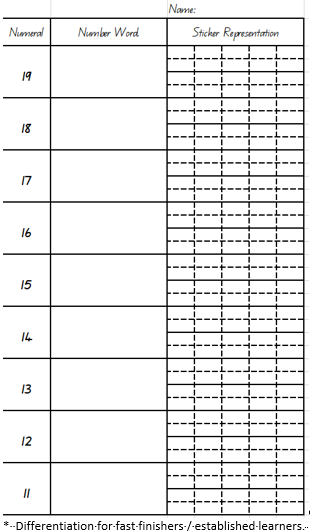
Formative Assessment: PST to collect and review all work to confirm student understanding of learning objectives and achievement of success criteria. PST then to provide student work to supervising teacher [ST] for student portfolio.
End of Lesson review
Discuss
- Today we learnt to spell the number names and match them with their corresponding numerals.
- We also learnt how many pictures represent the numerals.