This article extends on the previous two articles written on fractions. You can find those articles here and here. The learning experiences designed for this article support learners in a classroom to deepening their understanding through fractional thinking by being provided multiple opportunities to partition collections, such as playing fractional games, buttons, coins, unifix cubes, attribute blocks, Cuisenaire rods, dice, MABs, Lego, stones, leaves, flowers, anything tangible teachers have in their toolkit1. As students are familiar with and have had previous instruction on identifying values in collections of coins2, sorting them and finding their fractional value solidifies that knowledge. Use of concrete materials and manipulatives promotes positive academic performance and behaviour management3.
Key ideas
In Mathematics, the key ideas are the proficiency strands of understanding, fluency, problem-solving and reasoning. The proficiency strands describe the actions in which learners can engage when learning and using the content. From the activities provided in this article, learners will:
- connect visual representations with manipulatives (Understanding).
- model partitioning collections into halves and quarters (Fluency).
- explain methods for creating fractional collections (Problem Solving).
Partitioning collections into halves / quarters
In a classroom setting, the following activity can be used as an opener. Have 24 magnetic counters displayed in messy pile on board.
Think-aloud how to halve:
- Halves are two equal groups.
- Count counters (24) and organise into 2 straight lines.
- I can think of half of 24.
- If I’m stuck, I can think of half of 20 is 10; and have of 4 is 2. And that 10+2=12.
- I can draw 2 squares/circles/rectangles move the counters into each group (1 counter at a time) until I have an equal amount in each group.
I have picked 24 above, but you can pick any number that is familiar to the learners. Perhaps there are 24, 26 or 28 students in the class. If you have an odd number of students, then count the teacher as the extra to get an even number.
Ask the following focus questions…
- How many students in our class? (24)
- Students have 30 seconds to think about: How can we show one-half/quarter of 24? and write their answers in their books. Students show they are finished by placing a thumbs up on their chest. Encourage fast finishers to find alternate ways of representation (division sentence, number story).
- Think.Pair.Share. answers with their group and then with class.
Continue think-aloud: break 2 groups of 12 into halves again (fourths/quarters). That 2 quarters equal half of the whole and that four quarters equal the whole. Repeat think-aloud with only 16 of the counters (halves/quarters). Think-aloud how to model write simple fraction sentences:
- One half of 24 is 12; 16 is 8.
- One quarter of 24 is 6; 14 is 4.
Make sure this is written/demonstrated on the board.
Consolidation activity 1 – finding halves of various collections
Hand out differentiated bags of collections.

Δ bags contain 16 counters of the same type.
ϴ bags contain 24 counters of the same type.
Π bags contain 24 counters of two different types.
Ask students to count the contents and share them between two students in the group (halves). Collaboration provides greater engagement3. Project instructions onto board. Support groups that need assistance. Encourage fast finishers to find other ways.
Formative assessment: check the groups are dividing into two equal shares.
Bring the group back to discuss the following focus questions:
- Did you make equal shares? (If no, explore further.)
- How did you know they were equal? (Same in each group.)
- How many items were in each share? (Δ 8; ϴ and Π 12.)
- Why does Delta groups have a different answer to Theta groups? (Different whole.)
Consolidation activity 2 – partitioning collections into quarters
Instruct students to put items back in bag and then swap bag with their group counterparts (Δ with Δ; ϴ with ϴ; Π with Π).
Ask students to:
- Share between each of the people in the group (fourths).
- Draw and/or describe their discoveries in the scrapbook.
Project instructions onto board. Support groups that need assistance. Encourage fast finishers to find other ways to partition collections.
Formative assessment: check the groups are dividing into quarter shares.
Solidify the experience by relating it to something learners know
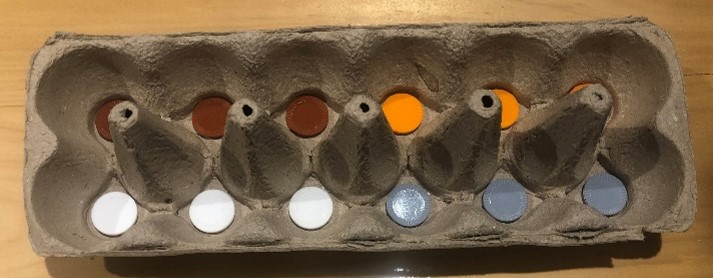
Use coloured counters to represent 1 dozen eggs. Think-aloud the different ways to divide the eggs (halves/quarters). Note to be mindful of egg allergies.
Focus questions:
- How many eggs are in a whole carton? (12)
- What if we halve the whole carton? (half a dozen is 6.)
- What if we divide the whole carton into quarters?
Move the counters around to represent the different fractions. Hand out 12 counters to each student. Ask students to:
- Move the counters into groups to represent half a dozen. Copy the representation in their books.
- Rearrange counters to represent quarters. Copy the representation in their books.
- Write a simple fraction sentence for half a dozen and a quarter of a dozen.
Fast finishers find alternate representations (such as collections of sets). Project instructions onto board.
Formative assessment: walk around the room checking on student’s drawings and fraction sentences.
Plenary
Have students take out whiteboards and markers.
Ask the following questions. Students to write down the answer and hold whiteboard to their chest when done. (Teacher reviews and notes anyone who will need additional support):
- Draw a square. From our Fraction Wall – how do we refer to the square? (Whole)
- Halve the square. When halving, how many parts to we need? (Two) Does there need to be anything special about them? Check our Fraction Wall (Equal parts. If needed, discuss equity/fairness.)
- Can you turn that halved square into quarters? How many portions do we need? (Fourths). Does there need to be anything special about them? (4 equal parts)
- Draw a circle.
- Halve the circle? Do we draw the line anywhere in the circle? (No.) How could we get equal parts? (Find the middle point by measuring with a ruler and draw a line through it).
- Quarter the circle? (Fourths. Don’t worry if not perfect).
References
Department of Education Western Australia. (2013) First steps in Mathematics: Number – Book 1. http://det.wa.edu.au/stepsresources/detcms/navigation/first-steps-mathematics/
Australian Curriculum and Reporting Authority. (2016). Australian Curriculum: Foundation to year 10 curriculum: Mathematics: Year 2: Number and Place Values: ACMNA034 (Version 8.3). https://www.australiancurriculum.edu.au/f-10-curriculum/mathematics/
Australian Curriculum and Reporting Authority. (n-d). Aboriginal and Torres Strait Islander Histories and Cultures. https://www.australiancurriculum.edu.au/f-10-curriculum/cross-curriculum-priorities/aboriginal-and-torres-strait-islander-histories-and-cultures/
Day, L., & Hurrell, D., (2017). Food for Thought: The role of manipulatives in the teaching of fractions. Australian Primary Mathematics Classroom, (22)4, 39-40.