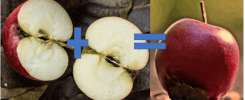
This article continues from my previous article which discusses the foundational conceptual thinking required for fractions. That thinking includes learner’s understandings of part, whole and equal parts. It is imperative that learners have a firm grasp on the concepts before moving onto quarters and eighths. Revisit these concepts if required.
Halves to quarters
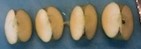
Using our apple or playdough that had been cut into two equal portions (halves) in the previous article, learners could cut each half into half again.
New vocabulary should be discussed (four parts, quarters, fourths) and these words could be added to the butcher’s paper or word wall. Using the apple or playdough, guide the learner to explore that two quarters are the same as one half and four quarters make a whole.
Ask focus questions like:
- Do you know a fraction we can make if we cut the apple? (halves, quarters)
- What name do we give the portions? (half, halves, quarter/s, part, share)
- What do we notice about the size of the pieces? Do all parts need to be the same size? (Explain.)
If working with playdough, give students time to consolidate their knowledge by reforming the playdough into a ball and cutting it into halves or quarters. They can even cut to quarters and reform them into halves before reforming the whole.
Quarters to eighths
It is easier for students to understand the jump from quarters to eighths if we move from concrete materials (the apple/playdough) to shapes. After all, how easy do you find it to eighth an apple? Imagine a little hand inexperienced in cutting equal parts. So for this concept a circle or rectangle works best.
Start by extending the thinking on quarters to be about shapes. Discuss with the learner if they can suggest how we might create eight equal parts in a circle. Extend this thinking to when you have pizza (assuming it’s cut into eighths). Are all pieces the same size? What fraction of the whole pizza is a slice (one-eighth/eighths).

Find a picture of a circular pizza online that is cut into eighths and that looks like the sort learner’s would see at home. The more realistic it is, the easier it is for the learner to make intuitive leaps. If you can’t find one online, then next time you order or make a pizza, cut it into eighths and take a picture.
Print the picture and have the learner cut out the circular shape. Then have them fold it in half (halves), and in half again (quarters) and then in half again. When the paper is unfolded, learners can see the crease lines that make the eighths. Cut along the fold lines as demonstrated below.
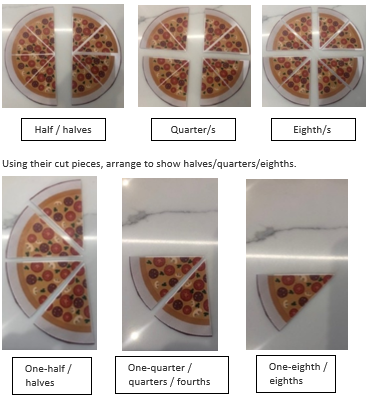
Use the following questions to gauge the learners understanding:
- How many pieces or eights are in a half? (Four).
- How many in a quarter? (Two).
Glue the pieces of pizza (to make a circle) into a scrap book for later reference.
Consolidation activity
It is great for learners to be able to represent eighths of a shape in different ways. Have students make their own fraction toolkits to strengthen their understanding of the relationship between parts and wholes (Gould, 2013). You will need to do the activity with or model this activity for the learner.
Model think-aloud:
- 1 rectangle = whole.
- I can make halves by folding the whole and cutting. I can make quarters by halving the whole and halving again. Continue for eighths.
- Each part of halves, quarters and eighths must be equal.
- Model fractional language.
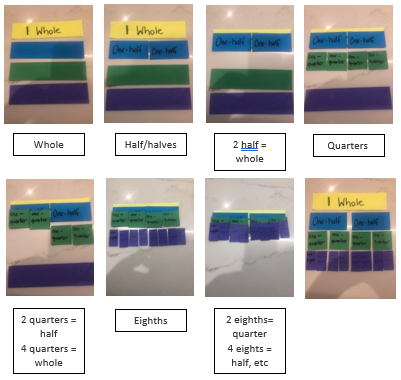
Check understanding by asking the following questions:
- Is there another way to find equal parts? Learners could measure with a ruler or they can place two halves over the whole, etc.
- Can learners use this same method to check if the folds are equal? Yes.
Fraction kits should be kept in a zip lock bag for future reference.
Review of whole, halves, quarters and eighths
To give learners a cognitive rest and because most 2nd graders love YouTube, review the concepts with the following fun video. I am not affiliated with Scratch Garden – I just really like their work. In case the video doesn’t play from my site – the URL is https://www.youtube.com/watch?v=362JVVvgYPE
Make sure that you discuss that although the focus is not on the written form of fractions, it is good to expose learners to the abstract representation. In year 2 the focus is on language: one-fourth/quarter and the repeated halving which year 2 uses to understand halves, quarters and eighths (Gould, 2013)).
Metacognitive traffic light exit ticket for teachers
Traffic light exit tickets are an efficient way for teachers to evaluate student learning and what needs to be reviewed before moving on to eighths as collections (Sondergeld, et al., 2010).
Hand out traffic light exit ticket that ask students to:
- Write their name on the sheet.
- Critically think about their understand of being able to halve/quarter/eighth different things and comment.
- Hand into teacher when finished.
Teacher reviews while students are at lunch.
What’s next
The next step is to introduce the learner to representations of halves and quarters of collections. I will consider this in the next article.
Curriculum
As you may know, the Australian Curriculum underwent a consultation process with an overhaul to some of the subjects. Mathematics is a subject that has had some changes. A comparison of the changes can be found here.
This idea meets the following content descriptors:
- Recognise and interpret common uses of halves, quarters and eighths of shapes and collections (ACMNA033) (ACARA (version 8.4))
- Recognise and describe one-half as one of two equal parts of a whole. Connect halves, quarters and eighths through repeated halving and interpret common uses of halves, quarters and eighths of shapes and collections (AC9M2N06) (ACARA (version 9.0))
References
Gould, P. (2013). Australia’s next top fraction model. Australian Primary Mathematics Classroom (18)3, 5-12.
Sondergeld, T., Bell, C., & Leusner, D.M. (2010). Understanding how teachers engage in formative assessment. Teaching and Learning, 24(2), 72-86.